

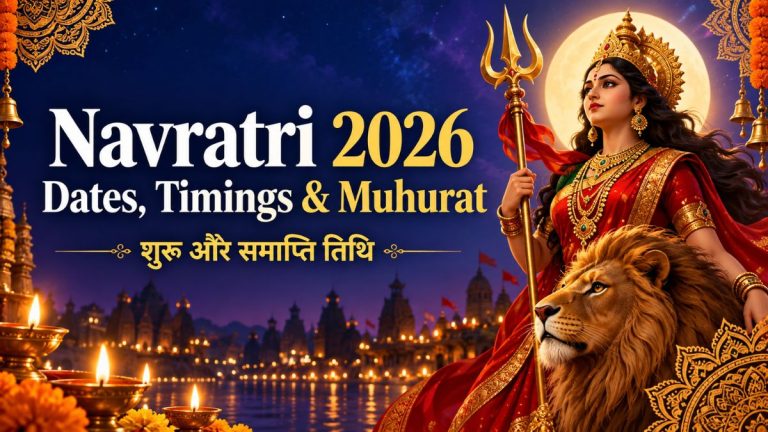
Sharad Navratri 2026 start date is 11th October 2026 (Sunday). After nine-days the festival will conclude on 20th October 2026 (Tuesday) with the celebrations of Vijayadashami. Navratri is a nine-day festival celebrated in honour of Goddess Durga and her nine divine forms. Navratri muharat starts with Ghatasthapana and Maa Shailputri Pujaon the first day. People do daily worship of different forms of Maa Durga. Maha Ashtami and Maha Navami festivities will be held on 19th October 2026. Vijayadashami or Dussehrawill be celebrated on 20th October 2026.
It is important to know the right Navratri 2026 dates, start and end dates, day-wise calendar, Ghatasthapana Muhurat, puja timings, Ashtami, Navami, Sandhi Puja and Dussehra dates. The correct Navratri muhurat and puja timings may vary according to the location. The best option to clear this confusion is to check city-specific panchang timings.
Navratri 2026 Dates
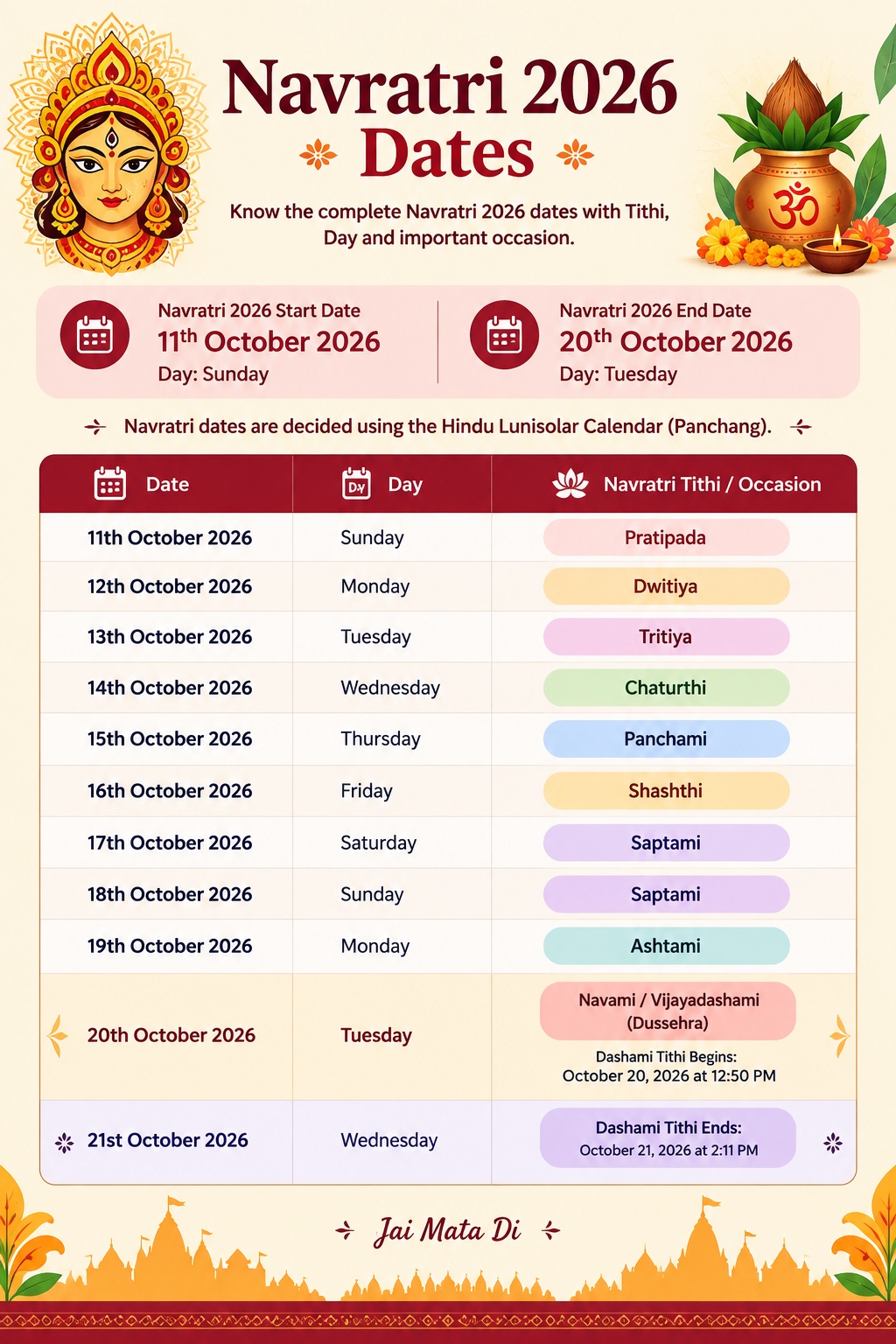
Navratri 2026 start date is 11th October. The day is Sunday; thus, enough time to prepare your home for the welcoming of Maa Durga. Navratri 2026 end date is 20th October 2026. Navratri dates are decided using the Hindu Lunisolar Calendar (Panchang). Here are the complete Navratri dates with Tithi.
| Date | Day | Navratri Tithi / Occasion |
| 11th October 2026 | Sunday | Pratipada |
| 12th October 2026 | Monday | Dwitiya |
| 13th October 2026 | Tuesday | Tritiya |
| 14th October 2026 | Wednesday | Chaturthi |
| 15th October 2026 | Thursday | Panchami |
| 16th October 2026 | Friday | Shashthi |
| 17th October 2026 | Saturday | Saptami |
| 18th October 2026 | Sunday | Saptami |
| 19th October 2026 | Monday | Ashtami |
| 20th October 2026 | Tuesday | Navami / Vijayadashami (Dussehra)
Dashami Tithi Begins: October 20, 2026 at 12:50 PM |
| 21st October 2026 | Wednesday | Dashami Tithi Ends: October 21, 2026 at 2:11 PM |
Navratri 2026 Start Date and Time
Navratri 2026 will start on 11th October 2026 (Sunday). As per Panchang calculation, Pratipada Tithi Navratri timings begin on 10th October at 9:19 PM and end on 11th October at 9:30 PM. The first day of Navratri is dedicated to Maa Shailputri.
Navratri 2026 End Date and Time
Navratri 2026 will conclude with Navratri Paranaand related observances on 20th October 2026, Tuesday. The same date includes Navami-related rituals, Ayudha Puja, Navami Homa, Durga Visarjan and Vijayadashami according to the cited Uttar Pradesh calendar.
The festival calendar therefore extends across 11th October to 20 October 2026. The exact time for Parana, Visarjan and other rituals depends on the local panchang and should not be treated as a single India-wide timing.
Check Navratri and Durga Puja Wishes
Navratri Saptami Date 2026
As per Hindu Panchang calendar, Navratri Saptami 2026 will be celebrated on 17th and 18th October, 2026. Saptami tithi is on two consecutive dates (17th and 18th October). The Tithi will change during 18th October from Saptami to Asthami.
Navratri Ashtami Date 2026
Navratri Ashtami 2026 will be observed on Monday, October 19th, 2026, as per the calendar. The exact timings of Devi puja and tithi should be as per the local Panchang for the devotees observing Navratri.
Navratri Navami Date 2026
Navratri Navami 2026 is on October 20th, 2026 and the day is Tuesday. On the same date, Mahadashmi starts at 12:50 PM and will end on October 21st, 2026, at 2:11 PM. Thus, the Navaratri pooja will be concluded on October 20th and not on October 21st.
Vijayadashami (Dussehra) Date and Time 2026
Vijayadashami (Dussehra) 2026 will be observed on Tuesday, October 20th, 2026. The Dashami Tithi begins on October 20th at 12:50 PM and ends on October 21st at 2:11 PM. Dussehra Vijay Muhurat is from 1:59 PM to 2:45 PM on October 20th, 2026.
| Events | Date and Time |
| Vijayadashami Date | October 20th, 2026 |
| Day | Tuesday |
| Dashami Tithi Begins | October 20th, 2026, at 12:50 PM |
| Dashami Tithi Ends | October 21st, 2026, at 2:11 PM |
| Vijay Muhurat | 1:59 PM to 2:45 PM, October 20th, 2026 |
Navratri Day-Wise Dates and Puja 2026
Navratri 2026 celebrations begin with Maa Shailputri Puja on 11th October. This festival celebrates the nine forms of Goddess Durga during the festival period. The calendar also includes observances regarding Ghatasthapana, Ashtami, Maha Navami and Vijayadashami.
| Navratri Day | Date | Tithi | Main Puja/Observance |
| Day 1 | 11th October | Pratipada | Ghatasthapana, Maa Shailputri Puja |
| Day 2 | 12th October | Dwitiya | Maa Brahmacharini Puja |
| Day 3 | 13th October | Tritiya | Maa Chandraghanta Puja |
| Day 4 | 14th October | Chaturthi | Maa Kushmanda Puja |
| Day 5 | 15th October | Panchami | Maa Skandamata Puja |
| Day 6 | 16th October | Shashthi | Maa Katyayani Puja |
| Day 7 | 17th October | Saptami | Maa Kalaratri Puja |
| Day 8 | 18th October | Saptami | Navratri observance |
| Day 9 | 19th October | Ashtami | Durga Ashtami, Maa Mahagauri Puja, Sandhi Puja, Maha Navami |
| Day 10 | 20th October | Navami | Ayudha Puja, Navami Homa, Parana, Durga Visarjan, Vijayadashami |
Navratri Colours
Navratri colors 2026 are tied to each day of the nine-day festival and are traditionally used for clothing and decorations. The sequence of colors may vary among various regional beliefs. So, it’s better to check the local panchang followed for the Navratri celebrations to confirm the list below.
| Navratri Day | Date | Goddess Worshipped | Colour |
| Day 1 | 11th October 2026 | Maa Shailputri | Grey |
| Day 2 | 12th October 2026 | Maa Brahmacharini | Orange |
| Day 3 | 13th October 2026 | Maa Chandraghanta | White |
| Day 4 | 14th October 2026 | Maa Kushmanda | Red |
| Day 5 | 15th October 2026 | Maa Skandamata | Blue |
| Day 6 | 16th October 2026 | Maa Katyayani | Yellow |
| Day 7 | 17th October 2026 | Maa Kalaratri | Green |
| Day 8 | 18th October 2026 | Maa Mahagauri | Peacock Green |
| Day 9 | 19th October 2026 | Maa Siddhidatri | Purple |
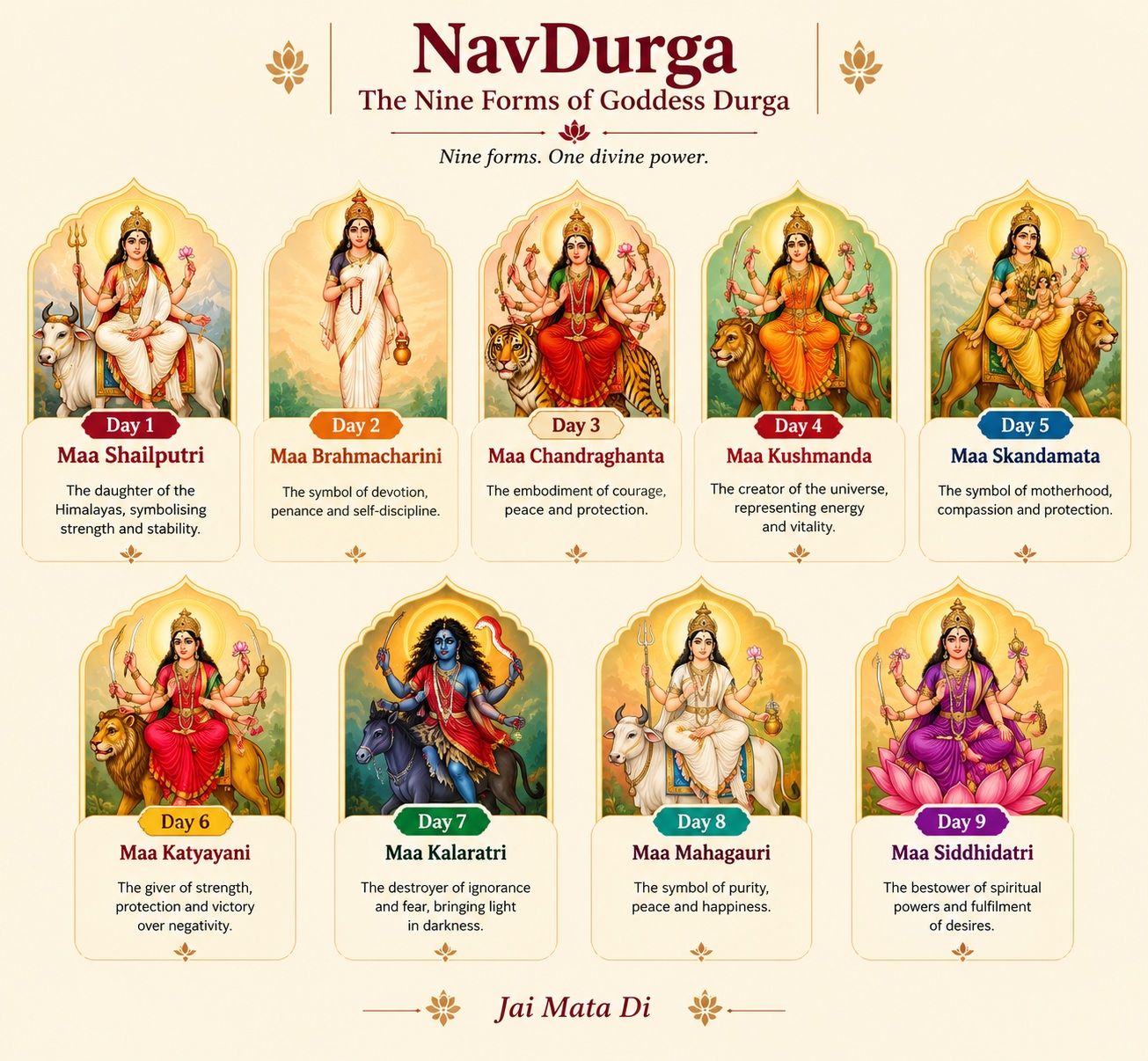
Navratri 2026: Nine Forms of Maa Durga
As utsav.gov.in, there are nine forms of Maa Durga worshipped during Navratri are known as Nav-Durga. These are said to be different forms of Maa Parvati and represent her life’s journey with hidden lessons. Each day of Navratri is traditionally associated with one form, beginning with Maa Shailputri and progressing through Maa Brahmacharini, Chandraghanta, Kushmanda, Skandamata, Katyayani, Kalaratri, Mahagauri and Siddhidatri.
| Day | Goddess | Significance |
| Day 1 | Maa Shailputri | Worshipped on Pratipada |
| Day 2 | Maa Brahmacharini | Associated with devotion and penance |
| Day 3 | Maa Chandraghanta | Represented with a crescent moon |
| Day 4 | Maa Kushmanda | Associated with cosmic energy |
| Day 5 | Maa Skandamata | Worshipped as the mother of Skanda |
| Day 6 | Maa Katyayani | Associated with strength and protection |
| Day 7 | Maa Kalaratri | Traditionally associated with protection from negativity |
| Day 8 | Maa Mahagauri | Associated with purity |
| Day 9 | Maa Siddhidatri | Traditionally worshipped on Navami |
Navratri Puja Vidhi
Navratri Puja Vidhi 2026 includes cleaning and decorating the main place of worship (in-house temple), Ghatasthapana or Kalashsthapana, diya lighting, offering flowers and bhog, worshiping Maa Durga and doing aarti. Devotees may follow additional rituals according to their family tradition, regional practices and local religious calendar.
Ghatasthapana Vidhi generally includes:
- The first thing is to clear the worship area and decorate it
- Place a clean Chawki (Platform) with a Kalash
- Fill the Kalash with water and then put Nango leaves and Narial (Coconut) over it
- Sow barley or other traditionally used grains in a vessel with a good surface area
- Perform diya lighting and begin the Navratri Puja
- Perform the daily aarti and offer bhog
These are just basic steps to do Navratri Puja. The exact steps can vary according to the tradition followed by devotees.
Navratri 2026 Fasting Rules
People have different rituals and rules for fasting. Some do not take salt at all, while some prefer to take sendha namak (rock salt). But the common practice is to avoid grains and products made from them. Navratri vrat is done for nine days. In many places, people do it for seven or eight days as well. Devotees planning to do Navratri fasting can follow these rules:
- Eating foods permitted during vrat
- Using rock salt instead of regular salt where customary
- Consuming fruits and permitted dairy products
- Avoiding grains and pulses where prescribed by the fasting tradition
- Avoiding certain vegetables and processed foods according to personal practice
- Maintaining adequate hydration
- Ending the fast according to the applicable Parana time
Why Navaratri is Celebrated?
As per www.incredibleindia.gov.in, Navratri is a time of prayer, devotion, deep rest and spiritual rejuvenation. The Art of Living says that these nine nights are a time to connect with the source of consciousness and to worship the nine forms of the Divine Mother Durga. The festival culminates in Vijayadashami, associated with the victory of higher, pure consciousness.
The Art of Living explains that the word “Ratri”refers to deep rest or relief from three types of disturbances: physical, subtle, and causal. Therefore, Navratri is viewed as a period to reduce distractions, pray, meditate and rejuvenate oneself.
The nine days are also associated with the three Gunas: Tamas, Rajas and Sattva. The first three days are Tamas or inertia, the next three are Rajas or activity and restlessness, and the last three are Sattva or purity and higher energy. Vijayadashami represents moving beyond these three Gunas and celebrating life.
How Many Types of Navratri Are There?
There are four main types of Navratri celebrated during the year in the Hindu calendar. These are Chaitra Navratri, Sharad Navratri, Magha Gupta Navratri and Ashadha Gupta Navratri. Among these, Chaitra Navratri and Sharad Navratri are widely observed, while the two Gupta Navratris are mainly associated with specific spiritual and Shakti traditions.
| Type of Navratri | Hindu Month | Main Period | Significance |
| Chaitra Navratri | Chaitra | March–April | Marks the beginning of the Hindu New Year in several traditions |
| Sharad Navratri | Ashwin | September–October | Most widely celebrated Navratri; associated with Durga Puja and Dussehra |
| Magha Gupta Navratri | Magha | January–February | Mainly observed by devotees following Shakti and spiritual practices |
| Ashadha Gupta Navratri | Ashadha | June–July | Primarily observed for spiritual and tantric practices |
Navratri 2026 Wishes, Quotes and Messages
Navratri wishes 2026 can be used on WhatsApp, social media, greeting cards and personal messages. Devotees generally exchange wishes for blessings, happiness, peace and prosperity during the festival. These messages can be composed in English, Hindi or regional languages.
Navratri Wishes 2026
- May Maa Durga bless you and your family with happiness, peace and prosperity. Happy Navratri 2026.
- Wishing you nine days of devotion, positivity and divine blessings. Happy Sharad Navratri.
- May the blessings of Maa Durga bring peace and prosperity to your home. Jai Mata Di.
- May this Navratri fill your life with strength, happiness and new hope. Happy Navratri 2026.
- Wishing you and your family a blessed and peaceful Navratri.
Navratri 2026 FAQs
Ques: When is Ghatasthapana for Navratri 2026?
Ans: The ceremony of Ghatasthapana will take place on 11th October 2026. It marks the beginning of Sharad Navratri.
Ques: When is Sharad Navratri 2026?
Ans: In 2026, Sharad Navratri starts on 11th October 2026 and the Navratri festivities come to an end on 20th October 2026 with the celebrations of Vijayadashami.
Ques: When is Dussehra 2026?
Ans: Dussehra or Vijayadashami will be celebrated on 20th October 2026, Tuesday. It is the end of Navratri festival period. Vijayadashami and Durga Visarjan are performed on this day.
Ques: Is Navratri celebrated for nine or ten days in 2026?
Ans: Although Navratri is a nine-night festival, the calendar dates for 2026 go until 20th October, owing to the placement of lunar tithis and associated observances for Vijayadashami.
Ques: Are Navratri timings same across India?
Ans: No! Navratri timings varies by location because Hindu calendar calculations consider local sunrise, sunset and tithi timings. Ghatasthapana, Sandhi Puja and Parana timings should therefore be checked for the relevant city.
Ques: What are the nine forms of Maa Durga?
Ans: The nine forms are Shailputri, Brahmacharini, Chandraghanta, Kushmanda, Skandamata, Katyayani, Kalaratri, Mahagauri and Siddhidatri. These forms are traditionally worshipped during the nine days of Navratri.
Get More Quotes on Our App
Download the Postly app for fresh wishes, shayari, status, and quote images.
Download App